Learn · Plug-In Solar
Plug-in solar in New Hampshire, explained
Starting January 1, 2027, New Hampshire homeowners and renters can plug a small solar setup into a regular wall outlet, with no permit and no sign-off from the utility. Here's how it works and what it will realistically do for your electric bill.
The new law
What changes on January 1, 2027
In July 2026, Governor Ayotte signed SB 540, New Hampshire's plug-in solar law. Once it takes effect on January 1, anyone with an electric meter, whether they own or rent, can connect a small solar system to their home by plugging it into a standard outlet. You'll also hear it called balcony solar, since it first caught on with apartment renters in Europe who hang a panel or two off the railing.
The size limit is 1,200 watts per meter. That isn't a lot of power. A microwave running on high pulls about that much, so think of it as the most a plug-in system can feed into your house at any one moment.
What you skip is the paperwork. A permanent rooftop system needs a building permit and an interconnection application with the utility, and getting approved takes weeks. A compliant plug-in system needs neither, and the utility can't charge you a fee or make you wait for approval before you plug it in.
There's one catch, and it shapes everything else on this page: you don't get credit for power you send back to the grid. Plug-in systems are exempt from net metering. If your panels are making 800 watts and your house is only using 300, the extra 500 watts flow out through your meter and you aren't paid for them.
How it works
What's actually happening when you plug it in
Solar panels make DC power, and your house runs on AC. The piece that bridges the two is a microinverter, a small box that mounts on or near the panels and converts their output into the same 120-volt power that comes out of your outlets. A cord runs from the microinverter to an outlet, and that's the whole connection.
From there, the power doesn't go anywhere special. It feeds whatever happens to be running in your house at that moment, like the fridge, the furnace blower, or the dehumidifier in the basement, and you pull that much less from the grid. When the sun goes down, the microinverter shuts off and the house runs on utility power like it always has.
The microinverter also handles safety. If the grid goes down, it shuts itself off within a couple of seconds so it isn't pushing power into lines a utility crew might be working on. That's one of the things the UL 1741 listing on a spec sheet tells you. It also means a plug-in system won't keep anything running during an outage. When the grid is off, so is your solar.
What it produces
How much power will it make in New Hampshire?
A two-panel system in a decent spot here will make somewhere around 900 kWh a year. The panels you pick, how much shade the spot gets, and which direction it faces will push that number up or down.
For a sense of scale, a typical New Hampshire home uses around 650 kWh a month. So a plug-in system makes about six weeks' worth of a normal home's electricity, spread across the whole year.
As for money, Eversource's current residential rate works out to about 26 cents per kWh once you add the supply and delivery charges together. At that rate, 900 kWh is worth a little over $200 a year, and NH Electric Co-op members land in the same neighborhood. That assumes your house uses every bit of it as it's made, though, which brings us back to the catch.
Because exported power earns nothing, timing matters. A house with a well pump, a chest freezer, and someone working from home will use more of its solar than a house that sits empty with the heat turned down until 6pm. If your daytime usage is low, some of that 900 kWh goes out to the grid for free.
Equipment
What to look for if you build one
We don't sell or install plug-in systems. They're meant to be a do-it-yourself project, and there are plenty of ways to put one together. But we spend our days around solar equipment, so here's what we'd look at if we were setting one up.
On the inverter side, the APsystems EZ1-LV is a good example of what to look for. It takes two panels and puts out up to 900 watts, which keeps you comfortably under the 1,200-watt limit. It runs on regular 120-volt household power and has a phone app that shows what it's producing. The EZ1-LV is probably the most simple, plug and play version of balcony solar. If you go that route, make sure you're buying the LV model, since that's the version made for North American outlets. Expect more options to show up as more states pass laws like this one.
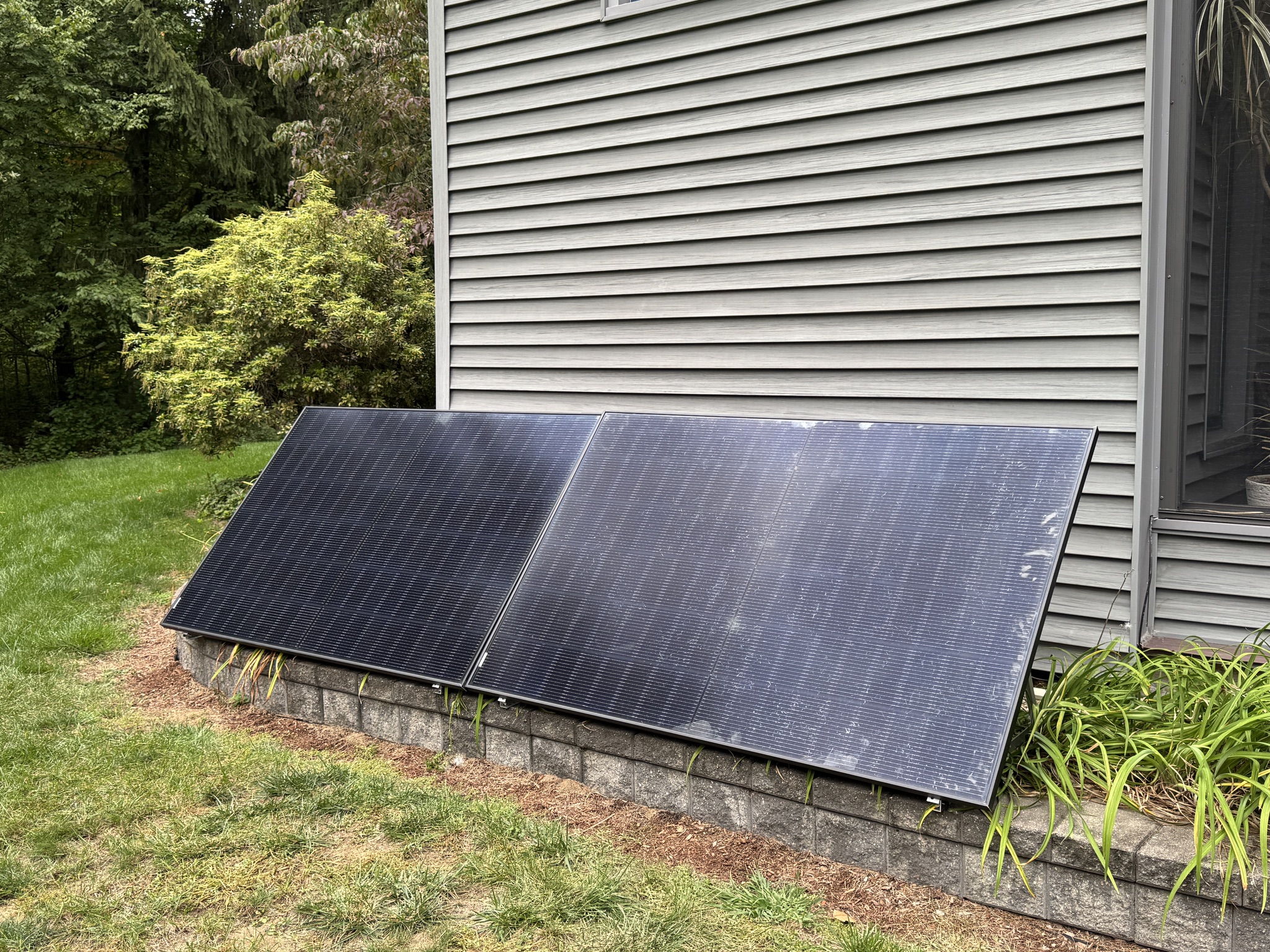
Panels are where you have the most choice. Big commercial panels in the 570 to 600-watt range, like the SEG Yukon N 590, are roughly 90 by 45 inches and weigh about 70 pounds each. A pair of them can maximize total production from 1 EZ1-LV, so it runs at its full 900 watts more often. The downside is the aesthetic of silver frames which can look ugly and the size is quite large. These are not more efficient than residential 440W options, just longer in length.
Residential panels are the other common route. Something around 440 watts, like a JA Solar 440, is closer to 68 by 45 inches and usually has a black frame. You give up a little production compared to the big commercial panels, but they look cleaner and they're a lot easier to carry and move arround.
Where you buy matters too. The inverter is small, so ordering it online from a reputable solar supplier is easy. Panels are a different story, since shipping big sheets of glass to a house gets expensive fast with some providers charging as much as $500 for the shipping alone. It usually makes more sense to call a local solar distributor, buy a couple panels, and pick them up yourself. There is really no need to be too picky on the solar panels they have available. Just ask what they have in stock and pick the cheaper $/W option because they are all pretty comparable in performance.
If you're comfortable with used equipment, lightly used panels show up on Facebook Marketplace and Craigslist pretty often and can save you some money. Skip anything with cracked glass or a bent frame, and check the label on the back. The open-circuit voltage (listed as Voc) needs to be under 60 volts to work with the EZ1-LV.
Before you plug in
A few things worth getting right
Be picky about the outlet. Your breaker only measures the current coming from your electrical panel. It has no idea your solar is adding power to the same circuit, so the wiring can end up carrying more than the breaker thinks it is. Avoid circuits that already run a space heater, a window AC, or anything else that draws a lot of power. If your house has older wiring, or you're not sure what else shares that circuit, have an electrician take a look.
Buy certified equipment. The law requires plug-in systems to be certified by a nationally recognized testing lab. It also has the state warn that an uncertified system, or one installed against code or the manufacturer's instructions, could affect your homeowners or renters insurance. Cheap no-name kits aren't worth that risk.
Put it where the sun is. Facing south with clear sun from mid-morning to mid-afternoon is ideal. A deck railing, the side of a shed, or a simple ground mount can all work. Shade from trees or a roofline cuts production more than most people expect.
Renting? The law covers renters too, but your lease and any building or HOA rules still apply, so check those first.
The bigger picture
What a full solar system does that plug-in can't
We think plug-in solar is good for New Hampshire. It's an easy, low-risk way to see solar work on your own house. It's also worth being clear about what it is. A typical home here uses close to 8,000 kWh a year, and a plug-in system covers a little over a tenth of that.
A permanent rooftop system is designed around what your home actually uses. One of our customers in Chester, NH has an 8.1 kW system with eighteen panels, designed to make about 9,600 kWh a year for a home that uses around 7,600. That's more than ten times what a plug-in setup produces.
Because a rooftop system is interconnected with the utility, the extra power it makes at midday earns credit through net metering instead of going out for free. It can also be paired with a battery, so the fridge, the lights, and the well pump keep running when the grid goes down. Over thirty years, that Chester home would spend about $109,600 buying electricity from the utility, and the model shows their system paying for itself in about seven years and four months. See the full Chester breakdown.
Free consultation
Understand your home's energy potential
If plug-in solar got you wondering what your whole roof could do, we'll run the numbers with you. Book a free remote consultation and we'll look at your roof and your electric bills ahead of time, then walk through the 30-year math for your house on a screenshare. No sales pitch, and if solar doesn't make sense for your home, we'll tell you.